Creating Natural Pigments: A Day of Making Colour from Nature
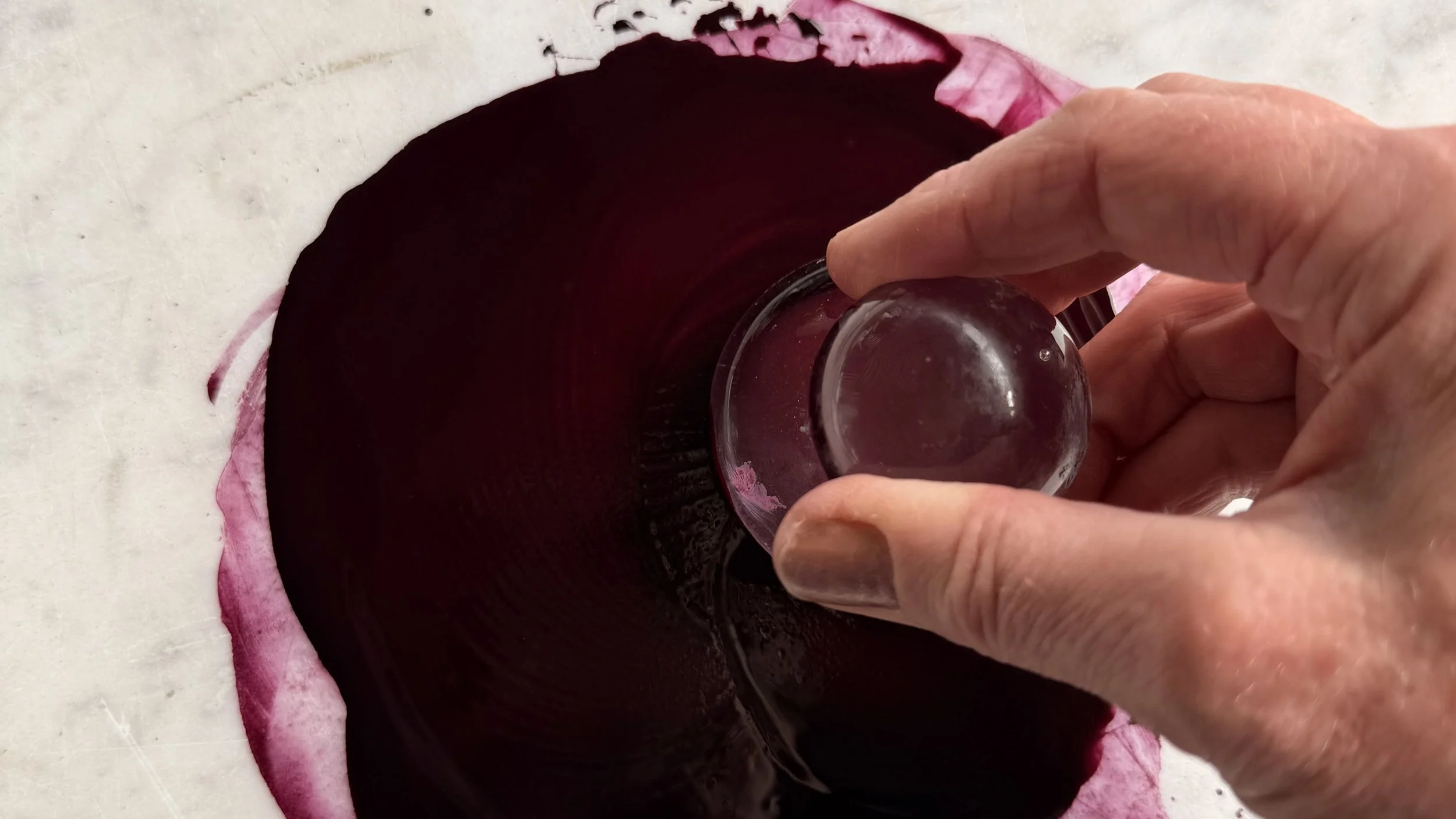
Using the muller to finely grind and blend the Cochineal pigment into the paint medium.
Recently I had the wonderful opportunity to spend time with Trudy Brothwell, whose knowledge of creating pigments from natural materials is truly inspiring.
We met at Trudy’s colour workshop in Nottinghamshire, where her background is in farming, textiles and rug making. Trudy introduced me to the fascinating process of making natural pigments for watercolours, pastels and paints. In just a couple of hours, I learned how plants, earth, ash, leaves, roots, seeds, flowers, bark and other natural materials can be transformed into beautiful natural pigments for painting.
For me, the day was about much more than learning a new artistic process. It felt like returning to something I had loved as a child; gathering natural materials, experimenting with colour and boiling concoctions, while also emphasizing how that curiosity can develop into sophisticated scientific art practice. Read About Me HERE.
What Are Natural Pigments?
One of the first things Trudy explained was that there are two types of natural pigments, Mineral and Earth Pigments and OrganicLake Pigments.
Mineral and Earth Pigments
These pigments are naturally occurring in rocks, soil and metal oxides found in the earth. These may be collected, or mined, washed and ground into a fine powder. Eg:
Ochres and Siennas are earthy yellows, reds and browns made from various clays.
Lapis Lazuli, is a rare blue rock which is ground down to give a bright, deep blue pigment.
Malachite, a green copper mineral has historically been used to create green pigments for paint.
Biological, Organic Colours and Lake Pigments
Organic pigments come from living things , such as plants, algae and insects. Eg:
Annatto seeds are deep orange and can be ground to extract the pigment,
Chlorophyll found in plant leaves creates a green pigment.
Female Dyactylopius coccus insects are dried, ground up and boiled to draw out the Carminic acid which creates the deep purple/red colour.
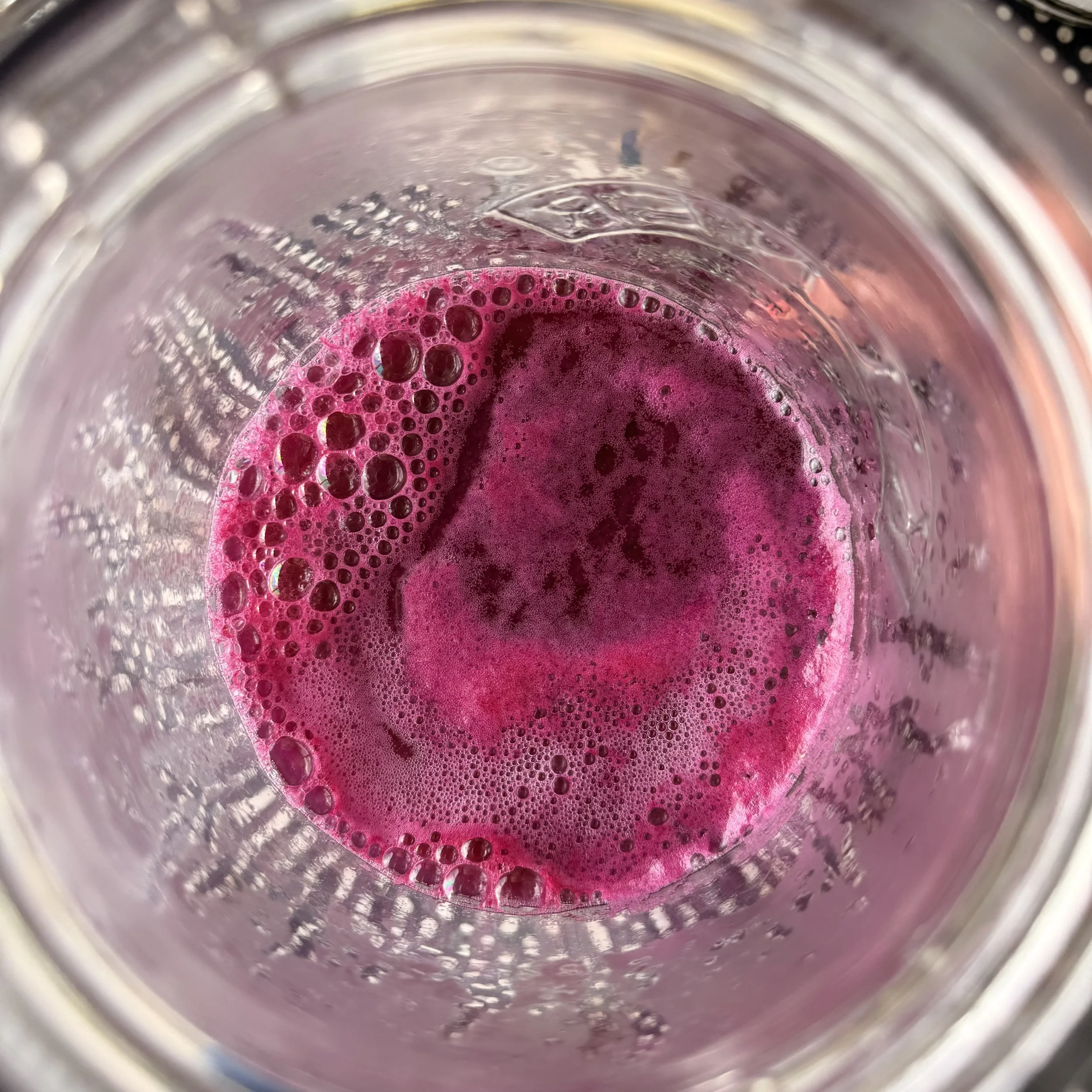
Solution of previously prepared natural Cochineal pigment.
Lake pigments
A Lake pigment is an insoluble powder created by chemically binding the water - soluble organic dye to an inert metallis base. Unlike Ochre or Malachite which are dug directly out of the earth as solids a lake pigment is made from liquids. It is a way to “trap’ a fluid dye and turn it into a solid powder which can be used paints, pastels or inks.
The Recipe: The liquid dye is extracted from plants or insects by boiling, freezing or squeezing . This watery solution is mixed with a metallic salt - usually alum ( aluminium sulphate) and a strong alkali like washing soda.
The Reaction: The chemical reaction causes the metallic minerals to bind tothe organic dye particles, precipitating a solid substance out of the liquid. To make a lake pigment these three components are always required; a dye, a metallic salt and an alkali.
The Result: The liquid fizzes and settles into a thick paste. Once filtered and dried it can be ground into a fine powder which will no longer dissolve in water. The pigments are translucent, ideal for watercolour , some may be affected by sunlight or fade over time.
Making Pigment from Natural Materials
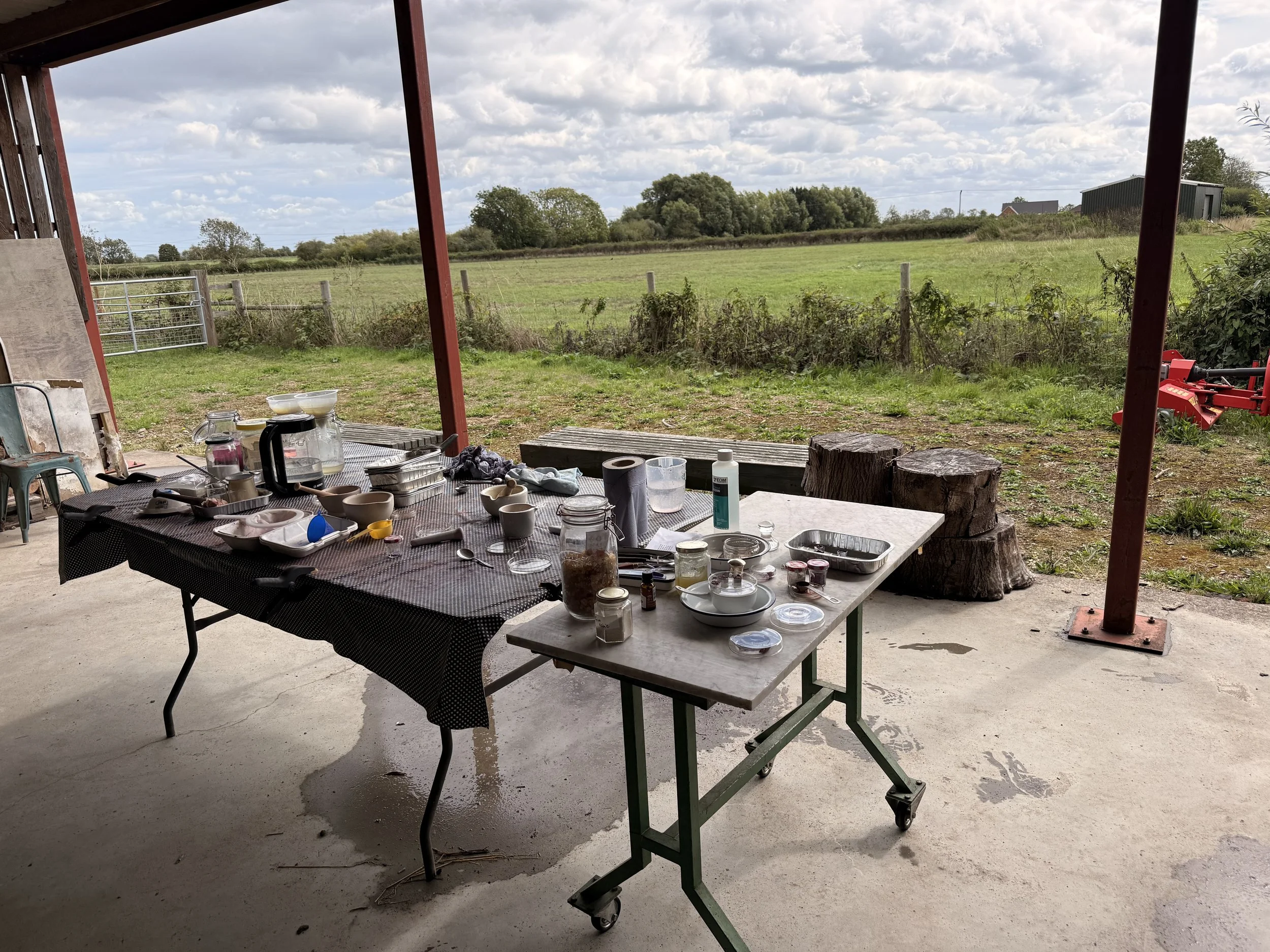
Trudy’s open air colour workshop, in Nottinghamshire.
Trudy's workshop was a wonderful set up with different areas for heating, storing, grinding, measuring and mixing.
We began with a pan of ivy leaves that had already been boiled in water and were cooling down. The colour had been extracted from the leaves, creating a pale green water solution.
The leaves were drained and the coloured liquid was transferred into a large Kilner jar.
Trudy then added Alum ( Aluminium Sulphate ) and Potassium Carbonate, this was where the magic really began to happen.
Almost immediately, the pigment began to react with the mordant creating a fascinating cloudy mass that billowed and slowly began tp settle towards the bottom of the jar.
This would then be left for at least three hours, or ideally overnight, to allow the coloured sediment to fully settle.
Once the pigment had settled at the bottom of the jar, the clear solution above it could be carefully removed and the remaining material filtered through a coffee filter and left to dry in a tray on a windowsill.
From Plant Material to Fine Pigment Powder
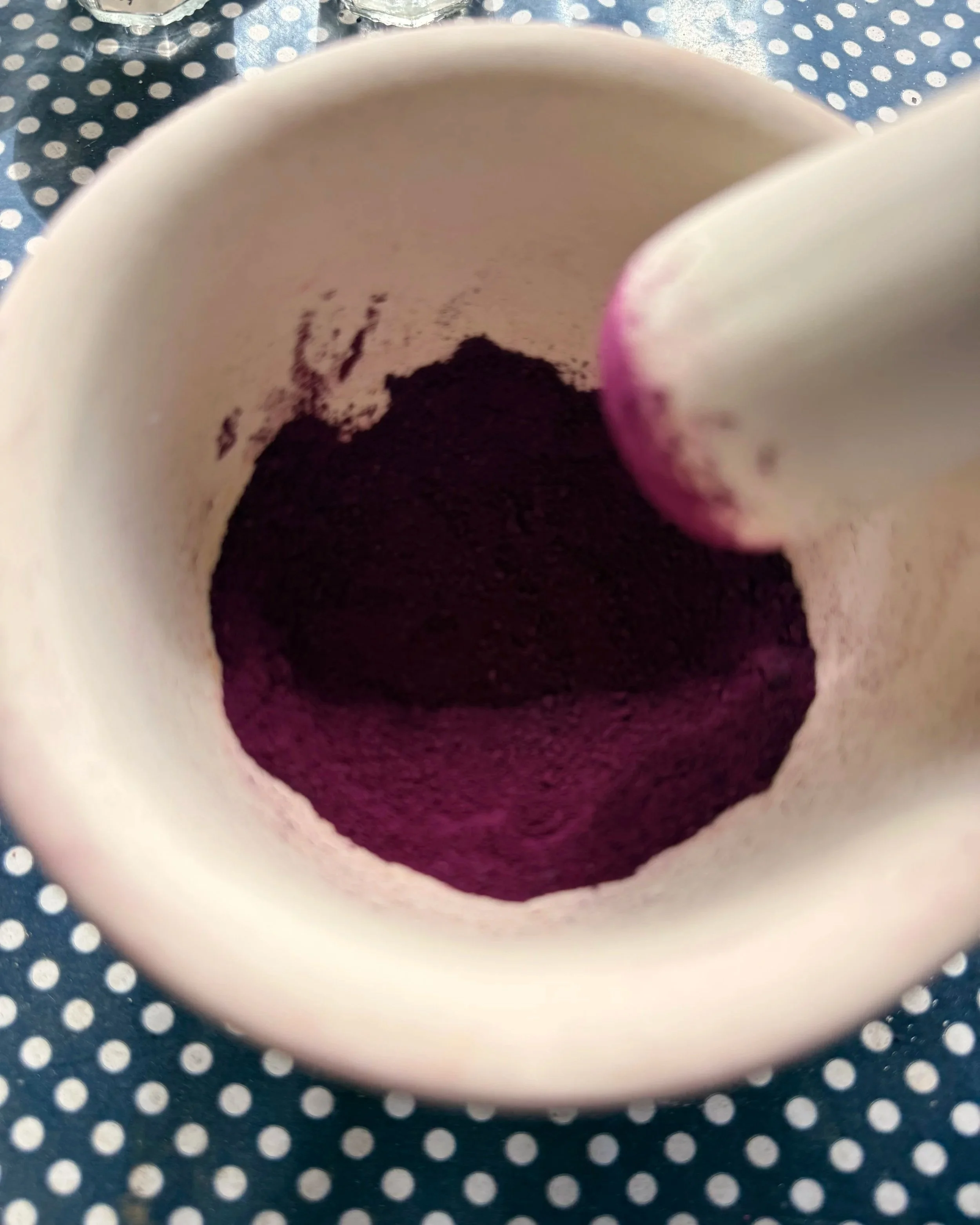
Cochineal pigment ground with a pestal and mortar.
Once completely dry, the coloured material could be scraped from the filter. But the process didn't end there. The dried pigment was then ground using a pestle and mortar, reducing it to an increasingly fine powder. It was then passed through a fine sieve so that only the smallest particles remained.
At this point you have your a beautiful, usable, natural pigment. Then there are many possibilities.
The finished pigment can be used to make watercolour, soft pastels, oil pastels and oil paints.
Browse my pastel drawing HERE.
Making Handmade Watercolour Paint
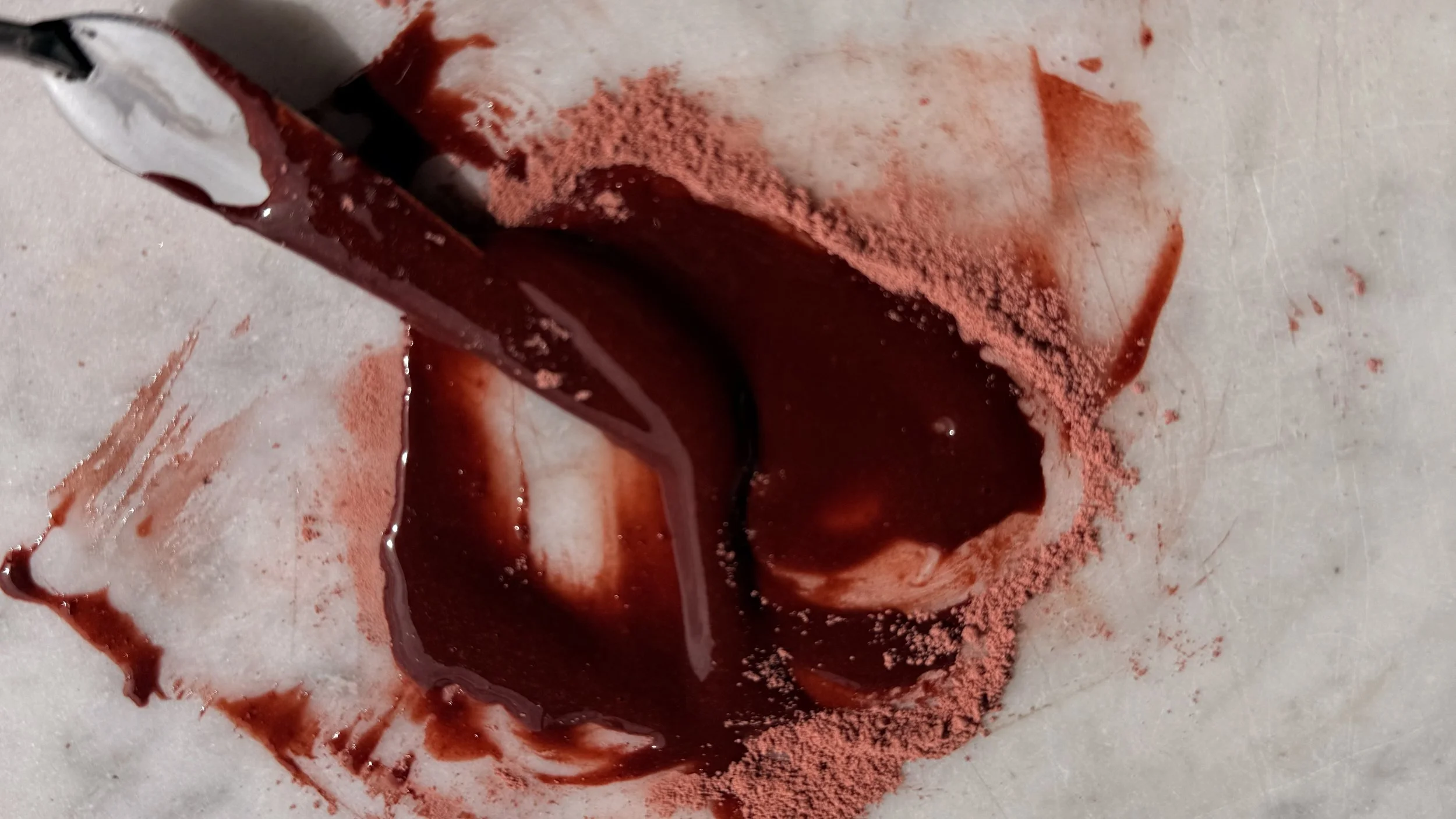
Ground Madder pigment being mixed with the watercolour paint medium; Gum Arabic and honey.
For our project, we decided to make tiny, precious squares of handmade watercolour paint.
To do this, Trudy mixed gum arabic and honey to create a binder for the pigment.
On a smooth marble slab, almost equal quantities of the pigment and gum arabic and honey mixture were placed together. With a palette knife, they were carefully combined before being worked with a muller.
The muller was firmly moved through the mixture accross the marble in a repeated figure-of-eight motion, gradually breaking down the tiniest grains of pigment. Slowly, the mixture developed into a wonderfully smooth consistency, rather like thick cream.
The finished paint was then carefully transferred with a palette knife into tiny square containers.
It was remarkable to see how quickly something that had started as a handful of leaves or natural material could become a tiny, highly concentrated gem of vibrant handmade watercolour paint!
With one of the colours we experimented by adding a tiny amount of Glycerine to test what effect this would have on the finished consistency of the paint.
Five Colours from Nature
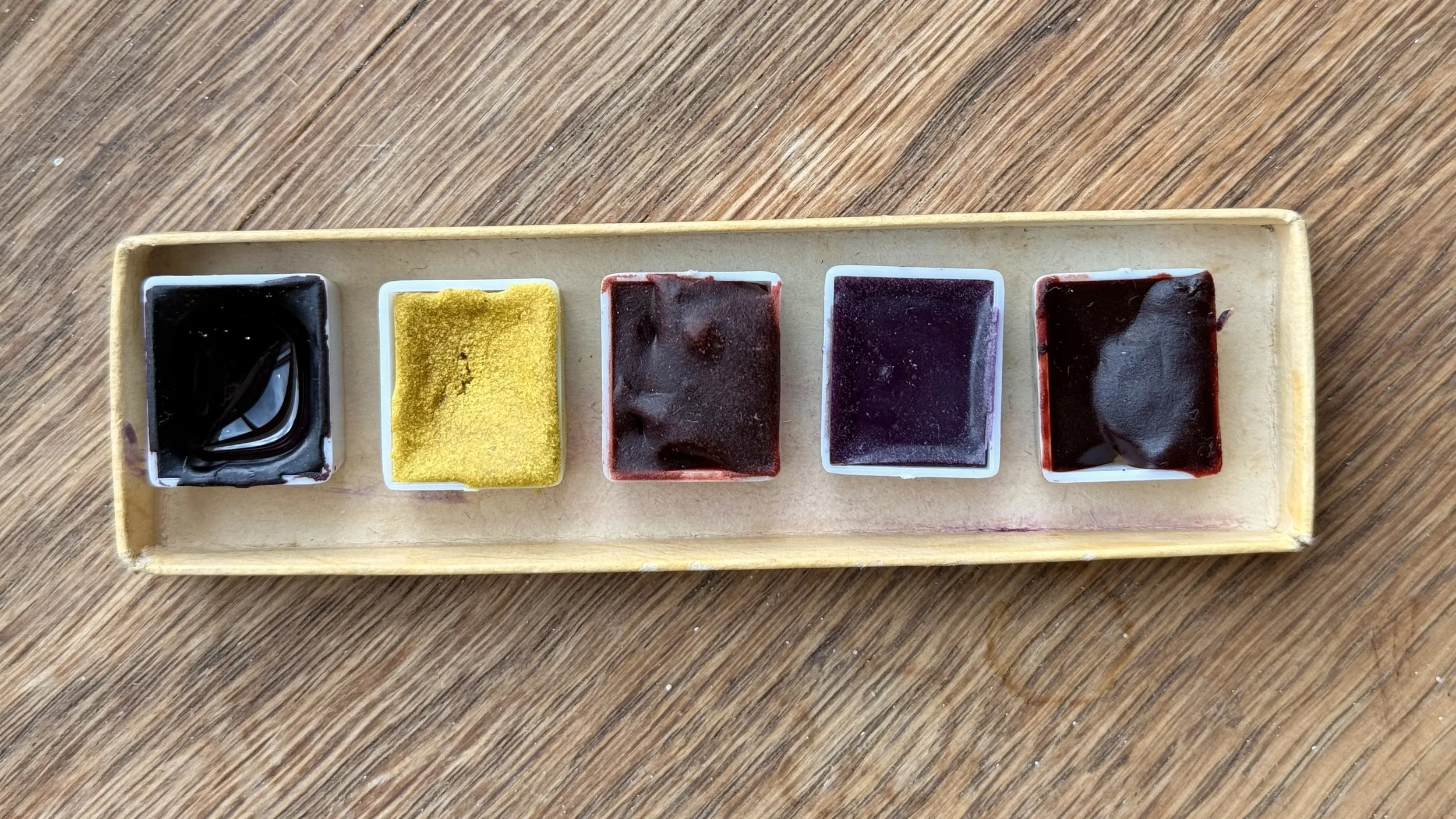
From the left: Cochineal, Apple, Madder ( with Glycerine,), Logwood, Madder ( without Glycerine)
In around two and a half hours, Trudy had created at least four different colours and two different paint recipes froma range of natural materials at various stages of preparation.
We had:
Rich crimson from Cochineal
Yellow from Apple
Deep Rusty red from Madder, this one without Glycerine.
Violet from Logwood
Another Madder an alternative recipe.with the addition on Glycerine.
I brought these precious handmade paints home with me, and I’m very much looking forward to using them and reporting my progress back to Trudy!
A Connection Between Art and the Natural World
I would love to use more natural pigments in my pastels and paintings, creating an even closer connection between my painting’s subject matter and the materials of the natural world that I am exploring.
There is something particularly meaningful about responding to a landscape or natural subject using colour that has itself come from the earth, plants, trees and other elements of nature.
It makes the relationship between subject, material and artist feel stronger and more connected.
Read about my drawing and painting projects HERE!
Coming Full Circle
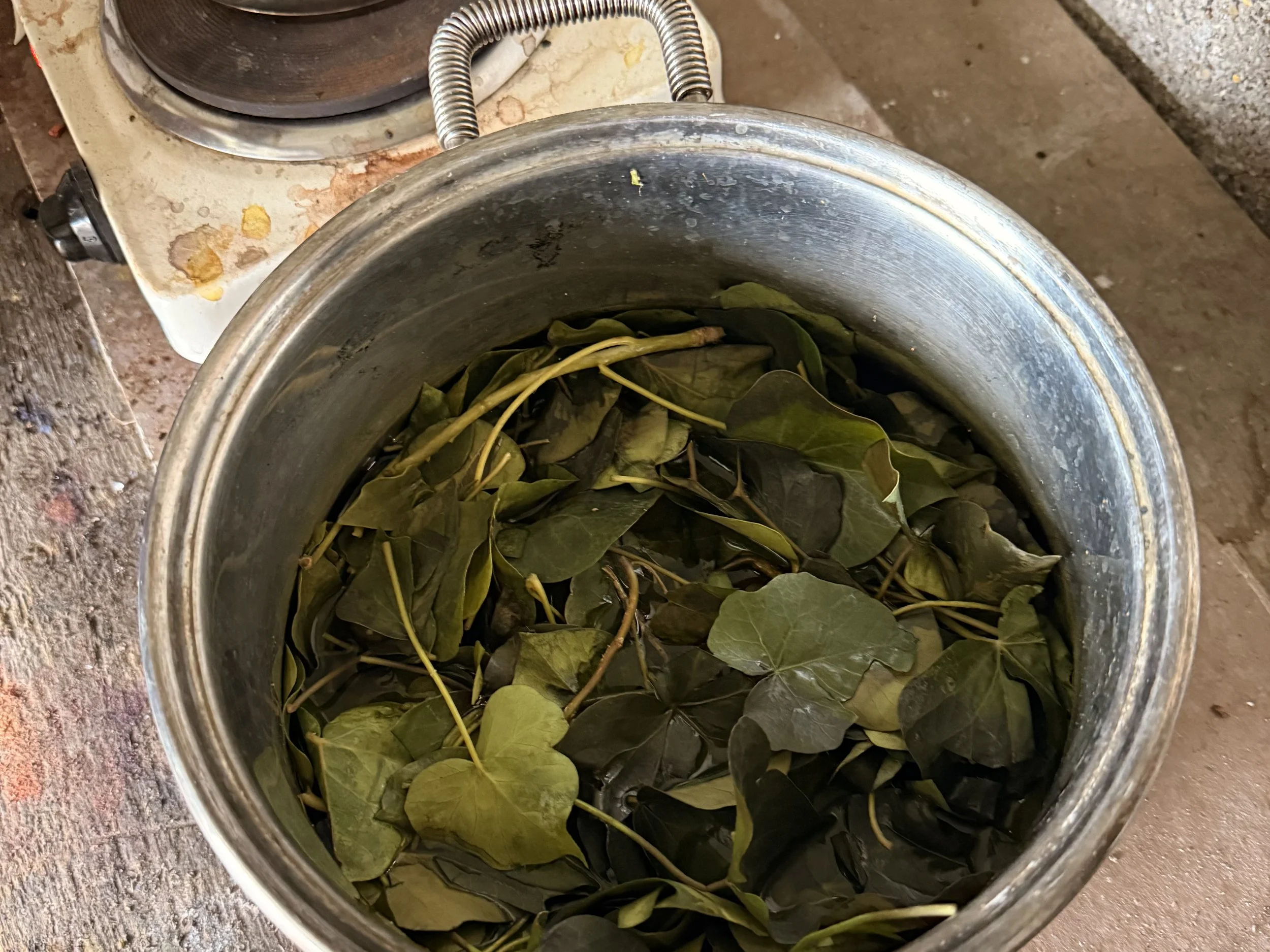
Pan of boiled Ivy leaves, cooling before being strained.
The day also connected me back to my childhood.
I was reminded of holidays spent at my Granny's house in Machynthlleth, Mid Wales, where there was no television and long February or October half term evenings were filled with puzzles, reading and craft activities.
One of my favourite things to do was making natural dyes or '“potions”.
I would experiment in the kitchen, having collected natural materials on our walks; trying to discover what colours could be made. I used things such as bark from trees, lichens, berries and onion skins from supper and blackberries. I kept a record of dyed wool samples in a little book.
Sadly, as I lacked knowledge many of those colours faded, but looking back, I realise that those childhood experiments were perhaps the beginning of my fascination with nature and colour.
Today, Trudy showed me how that same sense of curiosity can be taken further; how natural dyes and pigments can be made more permanent, how their intensity can be controlled, and how different components and processes can influence the final colour.
Looking both Back to the Past and Forwards to the Future!
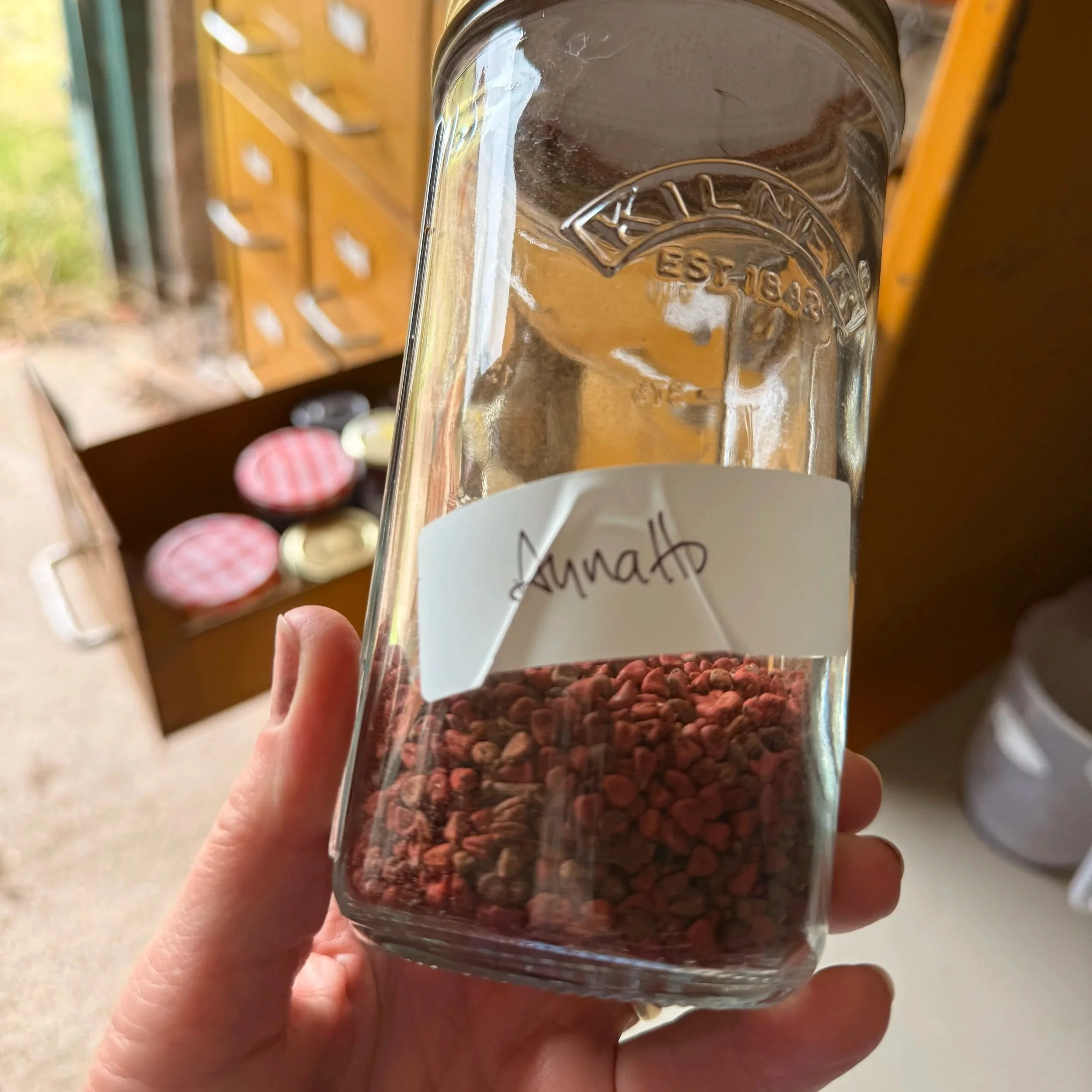
Dried Annatto seeds to be ground for the production of orange natural pigment.
There was something really wonderful for me about spending the day making colour from plants and natural materials.
I felt connected to my childhood again - collecting, experimenting and making dyes, but also it opened up possibilities for the future into a deeper understanding of natural pigments, botanical colour and a stronger bond between the subject matter in my art and the materials I use to explore it.
I left Trudy's workshop feeling inspired, carrying home five tiny squares of precious colour and a renewed desire to explore and understand what nature can offer an artist's palette.
To see my paintings and sculpture inspired by the natural world please browse my website HERE!
and Limited Edition Giclee prints HERE!
To find out more about natural pigment making workshop opportunities please contact Trudy Brothwell : trudy.colour@gmail.com